
Concerning Distant Relatives
David, Goliath, His Mother, and Parmenides

A little more than kind, but not quite kin; the distant relative: a stranger, a hanger-on to prosperity, a surprise at summer camp, a wedding guest with eyes aglitter, an inevitability, a branch on the oak overhanging your neighbor’s yard, a living fossil, a Patroclus, a dim star in the constellation altering your sister’s horoscope, a motif in the prelude, a looking-glass, an oat sowed in the wilderness, a Mr. Collins—the knot that binds your shoelaces with another’s under an Eastertide dinner table, which will not come loose for all the footsy of a long dessert.
Perhaps you will know of him by his peculiarity. (As a general rule, distant relatives who are not peculiar are passed over in silence: consider, for instance, the case of Adam and Eve’s other children in Genesis 5:4.1) You will be discussing some news with your mother, perhaps, a bit of society gossip, a real scandal, and she will begin to say, “As it happens, we’re related to someone—.” And then he takes the stage. And you hear the noise in the wings. And it is as the noise of many waters sloshing in dixie cups: a mighty noise alike unto the tumult of an encampment in the Poconos. And it is never quite clear how you are related to him: not even to your mother. At first, it is through your father. But your father denies this, ardently. Then your mother begins to speculate. (In the fashion of all great thinkers, she takes her conclusion for granted.) Certainly, he is related. He is at all the weddings, she says. Or at least he used to be at the weddings. In any case, he is involved in the matter under discussion. He was once employed at the antagonist’s brokerage firm in a senior role. When he was young, they say, he would wear velvet evening jackets and loafers with ostentatious buckles. It was the ‘80s! Your great aunt and him were once friendly, too friendly, until the incident (which she will not recount for all the cigarettes and gin in the world). Nonetheless, she regards him fondly. You ask if you have met him. Your mother says you must have. Perhaps you met him at your cousin’s baptism, which was somewhere in New Jersey you have not been to since. Does he live in New Jersey? —perhaps you ask this. And if you do, the answer is usually in the affirmative. Such distant relatives like to live in New Jersey. And yet, they do not all have the luxury: some live in Connecticut, others in Canada, and others still in France (never in the south), or ‘the nicer parts of Swansea.’2 In these places (and others still), they ply their trade, their object being the commission of an oblique diplomacy, which renders your immediate family involved with interesting subjects under discussion. Yes, say what you will about this sort of distant relative, but when you say anything at all you vindicate him. (In this way, he is like the firefly or a medieval heretic.)
But there is another and your mother’s eye has not seen him nor her heart imagined him—he is not the distant relative you know of, but the distant relative you know! The former is perceived as an airy peculiarity: he is as (and usually is) a tale that is told. This latter, though, you meet in life. You will be at a party talking with someone and as your conversation begins to wane, you will begin eavesdropping on the conversations of others. Then someone to your left will say that his family originally made their way to these shores from Austria, from a small town in the upper part called Gmunden, of which nobody has ever heard, though he has a relative who still lives there along the Traun and works, he thinks, in a ceramics factory. Then you will swing around in dull amaze and, after a moment or two, say with a violent stutter that your family also came from Gmunden and lived, according to your great-grandmother, somewhere near Schloss Ort, and that they left the town when that Schloss’s proprietor was declared lost at sea. Yes, he will say, his family left around the same time. A lot of people left. The town was brokenhearted. They followed the example of that erstwhile proprietor and went to the sea to lose themselves. But somehow, your family ended up in New York. As it happens, your new friend’s family also ended up in New York. And oh, what a coincidence! What a big city! What a very small world! And yet that world becomes smaller and smaller. Your new friend thinks he recognizes your great-grandfather’s name and you think you recognize the family business he mentions, which used to be involved in the import of medical salts but which now deals in car seats. Medical salts! Yes, you realize soon enough that you are fourth cousins (or second cousins twice removed?) and as you realize this you look into his face and suddenly you are utterly dumbfounded by the family resemblance. That nose! Those ears! The way his eyebrows trail into his temples, which reminds you of your uncle in Schenectady! Yes, you are face to face with the distant relative who is not distant at all, but inches away. And inch by inch you see what is relative and relatable. What’s more—you see that ‘distant’ and ‘relative’ are strange words to conjoin. For how long have we played with leaden tongues on the carillons of family gossip with this strangest of phrases—‘distant relative’—without recognizing its immensity?
Sometimes it is hard to tell the size of a thing until you see its shadow. (How revealing is an eclipse!) Consider distant relatives in literature. Some arrive as cousins: for instance, the dandy arriving to stir the provincial pot in Balzac’s Eugénie Grandet, the cruel Reeds and calming Rivers of Bronte’s Jane Eyre; and second cousins: Fluer to Jon (joined in love) in Galsworthy’s Forsyte Saga, Nick Carraway to Daisy in Fitzgerald’s The Great Gatsby; and, last but not least, mobs of kin: the parties interested in Jarndyce v Jarndyce in Dickens’s Bleak House, and, of course, the various branches of the Pyncheon family in Hawthorne’s House of the Seven Gables. Thus does the distant relative stand with his two feet on the open pages of popular novels with the print of his stride marking the progress of plots to comedy or tragedy by turns. It is a dance and like that of St. Vitus, we cannot do much to stop it or to stop ourselves from taking part.
To simply say that some great personage is a distant relative of another is enough to make the two greater than they were before and more than that make a sort of greatness of their relation: Consider the interior of an old chapel with two stained glass windows with two different scenes and then imagine the hues of those scenes crossing in the airborne dust, for instance, the cross of rays from the blood of some martyr’s wound and the green leaves of the Tree of Knowledge of Good and Evil—imagine that nexus of golden light hanging in the air! (Such gold is the stuff of which hereditary crowns were made.) Is it any surprise the bards of Wales took pains to transform Amlawdd Wledig into the maternal grandfather of King Arthur? And thereby Culhwch (whose forty anoethau could weigh creditably in the balances against the twelve Herculean Labours), into the latter’s cousin?3
In the Babylonian Talmud there is a tractate called Sotah (סוֹטָה) on the verso of the 42nd page of which there are a variety of opinions given regarding the biblical character Goliath. A certain rabbi says that because he is described as a champion of his peoples (אִישׁ הַבֵּינַיִם), that he was actually, per an interpretation of the Hebrew, the son of a hundred fathers and a dog. Not to be outdone, another rabbi opines that because he was called Goliath of Gath (גַּת), which bears a likeness to a Hebrew word for ‘winepress,’ that his mother was a common harlot who knew as many lovers as a winepress knows feet. Another rabbi proposes that because his mother was called ‘Orpah,’ (עׇרְפָּה), which bears a likeness to a Hebrew word for ‘behind,’ that his mother was the object of sodomy. And then yet another scholar opines that because of another likeness to a Hebrew word for groats, that she was threshed like the grain.
But then the text takes a remarkable turn. The discussion moves to the first chapter of the Book of Ruth in which the grieving Naomi, who has become a widow, addresses her daughters-in-law—Ruth, the great-grandmother of King David, and Orpah—who have, as it happens, also just become widows. (Often in life and more often in the Old Testament, nulla calamitas sola.) She tells them she has no more sons in her womb to give them, that she is too old to have another husband, that if she somehow did find another it would be ridiculous for the pair to wait until her new sons were marriageable, and that moreover, in her considered opinion, the Hand of the Lord was against her. Particularly, the passage cites the 14th verse of the chapter in which Ruth and Orpah, having heard all this lift up their voices and weep and embrace their mother-in-law: the latter kissing and the former cleaving and it is in reference to this touching verse that a certain Rabbi Isaac gives his opinion that Providence fated the descendants of the one who kissed to fall into the hands of the one who cleaved: that, per a teaching of Rava (which perhaps the other Rabbis had forgot), Orpah had then shed four tears for her mother-in-law and that for each she merited a mighty warrior to be descended from her and that one of these mighty was Goliath.
The text does not elaborate on the extraordinary implication of this statement (the discussion segues rather abruptly to a verse concerning the size of Goliath’s spear), which is that via his apparent descent from Orpah—who according to a tradition the other rabbis would ostensibly have been aware of that the latter was not only Ruth’s sister-in-law, but sister by way of Eglon4—it would follow that Goliath is King David’s distant cousin!
How different people are! When confronted with the fact of a great enemy, some leap to insult him (or his mother), whereas others, in the face of that same greatness, cannot help but see a likeness and in that a kinship. Greatness embraces greatness even in adversity. Thus does Rabbi Isaac sit in in an eisteddfod of sorts in the same company as the Welsh bards who asserted the relation of King Arthur to Amlawdd Wledig.
But can this company be excused for the liberties it takes with History or, for that matter, Scripture? Well, what is the weight of a thousand particular truths—a thousand fragments of bone, pottery shards, and other grubby pieces of junk collected by miserable graduate students—compared to Truth? Is it not the latter that is the object of our inquiries into History and Scripture? Whoever prefers the former can read a phonebook, but whoever seeks the latter sees at an instant that there is a poetry in the suggestion of David’s relation to Goliath so noble that it cannot be ignored, if not denied.
Without that Truth of distant relation, the textual narrative more or less consists of a battle between a ruddy-faced kid and a cartoonish giant settled via Deus ex machina. Its meaning is blunt and its color like a faded statue. But then with that Truth interposed between the lines of the text, the two become heroes of common stock meeting on the field of honor with fates born in twin embraces and ends determined by the character of those embraces. Goliath is born of weeping and David of cleaving and what is the drooping tear to the flesh that cleaves? Unlike Orpah, Ruth refused to abandon Naomi. Against all hope, she tells her, “Whither thou goest, I will go; and where thou lodgest, I will lodge: thy people shall be my people, and thy God my God: Where thou diest, I will die.” In the heat of that love, the tears of Orpah are but a summer storm. And so, Goliath for all his might fell into the hands of David, who would be king.
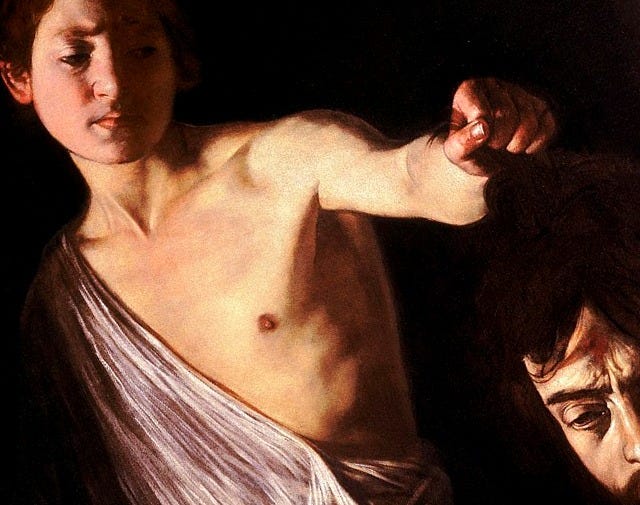
Here there is a cohering splendor: a drama that could be recited in the same breath as the Hildebrandslied without cause for comment—the sort which by nature is situated into that of the age-old contests of brother against brother, and (by a quite natural turn of psychological reflection) man against himself. Consider—is it a mere coincidence that art historians have long speculated that Caravaggio’s David with the Head of Goliath may well be a double-self-portrait? Given this and that all assertions of relation entail that of a sort of unity, could we not then imagine further that when the smooth river stone from David’s sling hit Goliath’s skull that the ensuing thud was a sort of echo of Galatians 3:28?5 Could we not imagine that in enmity there is always in each enemy a hidden likeness rendering difference and distance and relativity as such into illusions obscuring a single, sublime point of unity?
.jpg)
Is this the great secret of the distant relative—that all distance is relative, that in perspective all are one? Could it really be just that—the oldest cliché of popular pseudo-wisdom? The druggie, the podcaster, and the Eastern mystic (or at least a sort of caricature of him making the rounds in the West) walk hand-in-hand into the hotel conference rooms of the world and proclaim it joyously, saying moreover in explanation that Night and Day are but the twinklings of Time’s Star, that dreams and nightmares are but the spirit in inhalation and exhalation, that sleep itself is truer than waking life, waking life that truth refracted by appearance, and the appearance of Nature but World Spirit in a somnambulant struggle—and of course, in particularly inspired moments they will generally also note that the Good Life consists of nothing but a Good Death, that Death exists for Life, and that Good and Evil are simply two ends of a Very Big Snake trying to swallow itself and dizzy hapless alchemists.
It is the sort of idea that normal people tend to react to with a grin at best—and yet it is also the sort of idea that we cannot seem to shake off. There is something in it that accords with a reflective experience of the world. When we first look at the world, we see that things are different: one thing is this and another that. But then we look again and notice that these different things bear resemblances to one another: how a dining table is quite like a nightstand, for instance. Then, of course, tables, in general, remind us of stools and stools of chairs and chairs of ladders and ladders of towers and towers of trees and trees of the nervous system branching up our spines. The more we look the more likeness we see and eventually we begin to have the strange, almost maddening feeling that the world is something like a house of mirrors at the carnival—that everything is a sort of distorted reflection: that all chairs are distorted reflections of one chair, that all people are distorted reflections of one person, all instances of goodness distorted reflections of one good—and that moreover all these things are themselves but a distorted reflection of some one other thing somewhere among or just above the mirrors. And yet, when our reveries in this vein end and we open our eyes, we look at the world and there is not one thing, but many again and we are at a loss.
In Plato’s Parmenides, the young Socrates tries very hard to argue with the eponymous philosopher that there really is no problem with reconciling the one and the many. He begins by trying to defend an account of the forms crudely resembling that of Plato’s middle-period. But Parmenides presents difficulties: when Socrates argues that perhaps many things partake in the same form like many things do the same day, Parmenides says his form sounds like a sail covering many things with its many parts, meaning many seem to partake in many and not one; then when Socrates argues that perhaps many things can partake in a form because they partake in its character, Parmenides says if a form were so, for instance largeness, then though it would characterize large things, by being itself large, it would imply a second, greater form of largeness characterizing the set of things the first did plus the first itself, and so a larger, third form of largeness, and so on; then when Socrates argues that perhaps forms are like thoughts, Parmenides says thoughts must be thoughts of something and if such a thing partakes in the unity of the form then it would also be a form and that therefore all objects of thought are forms and moreover, if these thought-forms do not have many parts, then objects partaking in them must also be thoughts, meaning that everything is either thinking or that thoughts can be unthinking6; then when Socrates argues that perhaps forms are just patterns things are patterned after, Parmenides says these patterns would be quite like the things patterned after them and therefore be alike and patterned in a way by their likeness, which would be patterned after the form of likeness, which would then be alike many things, ad infinitum; then Parmenides notes an even greater difficulty with the idea of forms: that if they are absolute things and are what they are only in relation to other such absolutes then they would only exist in their own world and would have no relation to ours in which things are what they are in relation to particulars—that is, the form of mastery is what it is in relation to that of slavery, and masters in our world in relation to their slaves, but no worldly master is what he is in relation to the form of slavery itself, meaning we could only really know about things in our world and the gods of this other absolute world of forms the same of theirs (in the same way that they, being absolute, could only have mastery in relation to the form of slavery rather than particular slaves).
After this exasperating back and forth, it might seem as if the question of the one and the many were settled in the negative. But Parmenides is not finished. After all, he is a faithful monist and the author of a sizeable poem in dactylic hexameter (nowadays known as On Nature7) which preaches the good word of monism as divine revelation. He tells Socrates that without forms—without the idea of a given thing having a given character of sorts—dialectic is impossible and that anyways Socrates had only failed just then because he lacks proper training. To that end, Parmenides gives a demonstration of a sort of dialectical exercise with another character in the dialogue, Aristoteles, consisting of a series of deductions about what it would mean for a form to be the case and the contrary; what the meaning of such cases would imply; and what those implications would mean with regard to other things as well as the given form.
This demonstration, which dominates the rest of the dialogue, is popularly regarded by scholars and schoolboys alike as the most intellectually challenging bit in all of Plato’s work and yields such a rich banquet for thought that even now, though it has been over two millennia since that table was laid, the general consensus seems to be that there are dishes in it still as of yet untasted. But of course, this is not all that terribly remarkable given that most people just cannot stomach this sort of stuff. It sticks to their teeth and will not go down even after a great deal of munching and crunching. It is no small wonder that Aristoteles himself did not take up a philosophical career, but rather opted to become a man of the world, joining the ranks of the Thirty Tyrants and Four Hundred Oligarchs. Generally, in spite of what praises the wise give such things, mankind is wary of steaming heaps of deduction. (There is something endearingly humane about how, though Parmenides reasoned that worldly masters can never be absolute in their mastery, that Aristoteles seems to have given it the old college try anyways.)
Luckily for mankind, however, some of Plato’s other dialogues offer more palatable fare. In Phaedrus, for instance, an older (and presumably wiser) Socrates, without a Parmenides present to poke holes in his arguments, gives an exceedingly colorful account of the metaphysical adventures of the human soul, saying that some souls who have their wings and winged horses in good repair and are besides following the gods as closely as they can as they make their rounds on the upper rim of heaven, have the good fortune of glimpsing the forms and that later on, when a soul loses its wings and finds itself mucking about the earth, that whenever it seems to alight upon knowledge of anything true, it is actually remembering in a way that glimpse of higher Truth. Now that is some palatable stuff! And if there is something to it, then perhaps what is called for in the case of stomaching the answer to the question of the one and the many is a sort of helpful morsel, a transcendental equivalent to Proust’s madeleine, by means of which people can acquire a taste for that final course of sublime logic their humane pickiness has heretofore prevented them from enjoying.
But how should we cook up this transcendental madeleine? Well, perhaps like a real madeleine, we could make it spongey and sponginess is, of course, a matter of a yielding porosity: of alternating throughout the substance of the thing stuff which has a bite and which does not in a fine network capable of soaking up something like tea or coffee—which is to say opposites that nonetheless accommodate a given substance by virtue of the space between them. And what better opposites do we have at hand then likeness and unlikeness—those would make for a nice sponge cake that could soak all sorts of things up! After all, every sort of thing is at least a little like and unlike everything else, which is to say, a madeleine so constituted should be able to soak up the world.
But would such a madeleine taste any good? (That is the important question.) Well, consider that when a thing is suspended between likeness and unlikeness—when it is both familiar and unfamiliar—that it is then that there arises our peculiar taste for it; between the play of the two there is that scent of the thing we can never quite see, but hunger for nonetheless: in the look of a veil on a pretty face, stars as observed through a cloud, or the iridescence of a butterfly’s wing—it is neither the veil nor the pretty face, the stars nor the clouds, the sunlight nor the double-layers of scaly chitin for which we hunger, but the thing we perceive in hidden suspension. And if we could put all the world to our use, would it not stand to reason that that substance in suspension would be absolutely mouth-watering?
However, the cauldron of the world includes many unappetizing things—toads, shoelaces, poverty, old towels, and so on. For all our reason, how could we expect our madeleine to come out of the dipping the better? Well, consider again the distant relatives, the ones we know of involved in some scandal or another that our mothers have told us about whom we delight in because despite being distant, they are nonetheless joined to us by a likeness we suppose is latent in kinship; then consider again the distant relatives we know who we delight in because despite the distance of their relation, they are really beside us nonetheless; then consider again those distant relatives of history, literature, and myth whom we delight in because they abridge the distances and increase the relations of the wider world such that it seems the more coherent and poetically grand—but then consider the distance of all these relatives and ask yourself why only so far, but no more? Why are we generally delighted to discover a fifth cousin, but do not give a fig for a tenth? At such a distance, someone might well argue, the relation is negligible, but is it really—or do we just lack imagination?
If we would but stretch our imaginations along the lines of likeness, would we not find our sixth cousins as interesting as our fifth? And then our seventh, eighth, ninth and so on until we found all of humanity fascinating? And then by a further stretch, all creatures? And then all inanimate things? (We have iron in our blood and if we do not have enough, we die—what right then do we have to pass by an ingot without hailing it as a cousin?) Perhaps with our imaginations fired to such a heat, we could bake our transcendental madeleines and eat them with everyone else—David, Goliath, his mother, Parmenides, our scandalous great uncles, King Arthur, and so on—and in that communal feast whet our appetites for that higher logic by means of which, somehow or another, the many things of the world first differentiate in distance and relation, despite their multitudinous variety remain united, and have in that strange unity a single and absolute end:
“ἐν ἀρχῇ ἦν ὁ λόγος, καὶ ὁ λόγος ἦν πρὸς τὸν θεόν, καὶ θεὸς ἦν ὁ λόγος.”8
“And the days of Adam after he had begotten Seth were eight hundred years: and he begat sons and daughters.”
A fictitious city invented to sell poetry to gullible Americans.
See, for instance, Culhwch and Olwen, an 11th or 12 century narrative found in the Red Book of Hergest.
See Rabbi Beivai’s statement in the name of Rabbi Reuven in Ruth Rabbah 2:9.
“There is neither Jew nor Greek, there is neither bond nor free, there is neither male nor female: for ye are all one in Christ Jesus.”
Panpsychism is the sort of idea that makes sense if all the world doesn’t really need to think about it.
The original title is unknown.
“In the beginning was the Logos, and the Logos was with God, and the Logos was God.” (John 1:1)