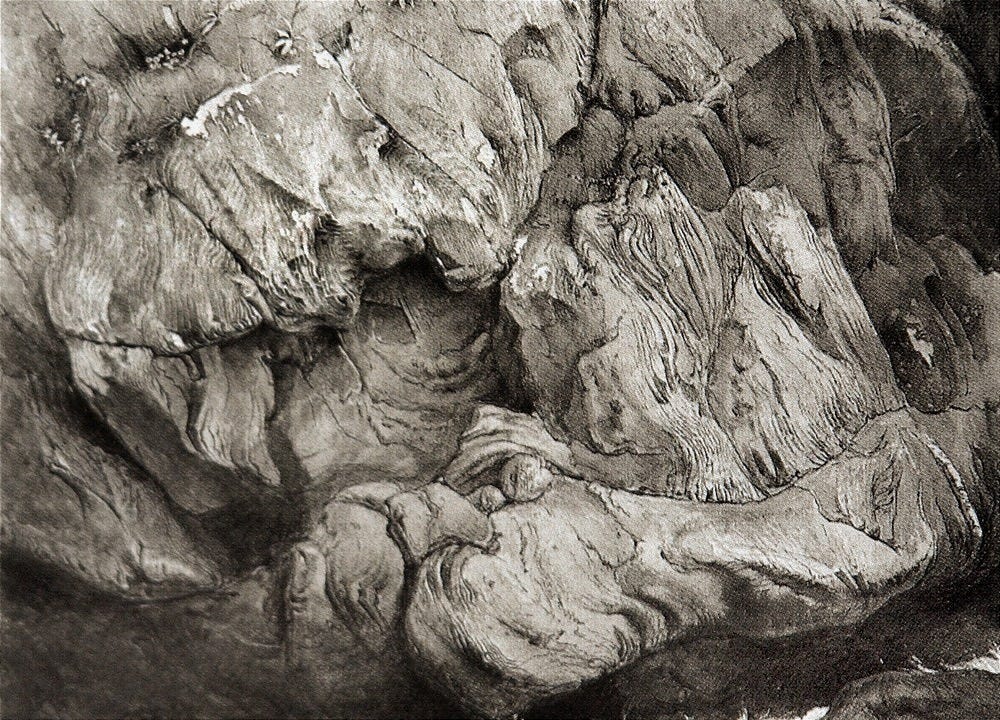
On Sketching
Why does anyone sketch? And I don’t mean, “Why does anyone make Art?” But rather why are there people who sit around sketching—not as an exercise in creative expression or even in preparation for such—but for its own sake? How are we to explain the odd people who camp out in public parks on sunny days to covertly sketch profiles of absolute strangers? Those creatures who sit for hours at a time in museums turning out detailed sketches of old sculptures and paintings the likes of which already exist and which will have no future more illustrious than that of records of their maker’s spare afternoons?
Yes, it’s an easy enough thing to understand why some people sketch Gratia Artis—why a person might sketch a thousand passing faces to sketch that one face that’ll define an era in the Louvre. But these other people—who are neither artists nor aspiring ones—what do they get out of sketching? It must be something. After all, they’re everywhere: you find them in galleries, on streetcorners, train stations—anywhere at all where there are picturesque things to be seen and agreeable seating options available. And if they keep at it for decades—which they often do—they sketch marvelously: their lines, their shading, grasp of form, etcetera rival even the best of that of the Old Masters.
Nevertheless, if you talk to them (and you should) you’ll learn they generally don’t sell their works nor consider them so much as objets d' art. They’re not even proud of themselves, usually. But for some reason they go on.
Why? At first glance, you might be forgiven in thinking what they’re up to is pointless: a benign mania like practicing scales on an invisible piano or transcribing dialogue from old films on the Turner Classic Movies Channel. Certainly, the world is full of follies and if anything looks foolish, chances are your eyes aren’t deceiving you.
But I don’t think this sort of sketching is a folly and that’s because I sketch.1
***
The way it all began is probably par for the course: Once upon a time, when I was young and the world my oyster, I imagined I’d become an Artist: that I would make paintings and sculptures. Often I would go to the Metropolitan Museum of Art, The Frick, MoMA, and other such places in or near New York City and looking around say to myself with all the assurance of youth, ‘What the people who made these things did, I’ll do too. It’ll be a fine way to spend my life.’
As it happened, however, I did not then know any artists nor even how one practically got started in that line. But I figured I’d better start sketching. (I’d already been doodling for some time in any case.) So, I went ahead and spent many a full and fulsome hour doing just that: during class, at home, and so on. Sometimes, I’d even skip my classes to sketch around the city, particularly in the Greek and Roman sculpture galleries at the Met. I found sizeable coffee table books of Medieval and Renaissance Art and sketched studies of everything that struck me as particularly difficult or beautiful. I imagined I had the makings of a latter-day da Vinci (and to that end copied sketches from his notebooks and practiced writing backward).
At some point while I was in high school, I succeeded in begging my parents to grant me art lessons. Certainly, the tutors they found by way of a local message board were less professionals and more neighborhood hobbyists. But I was nonetheless attentive to my tutelage and learnt how to sketch and paint decently. I even developed serious interests and ambitions in such things as architecture and fashion design.
When the time came, I applied to art schools. However, given that I knew no real artists nor for that matter anyone who cared to advise me on the finer points of the application process, my idea of what constituted a strong application was severely lacking. In my naivety I imagined all I had to do was show the good folks in the admissions departments a good portfolio.
I quickly learned, however, that admissions departments at art schools (or at least the ones I’d applied to) don’t only appreciate good portfolios, but good grades as well. And for better or worse, I’d neglected to get those. (If memory serves, I had the second lowest GPA in my class: it began with a 2 and didn’t go much further.)
So, I received letters from at least two or three of these schools saying that given my grades, they’d be happy to accept me into a program where if I achieved a certain minimum GPA, then after a set period they’d allow me to matriculate into the program for which I’d applied. I forget the exact details. The letters are in a draw of a childhood desk in a childhood home. I haven’t looked at them in over a decade. But when I last looked at them, I remember seeing the offers and with a vanity that rivaled my naivety declared to myself that if they wouldn’t have me as I was then they wouldn’t have me at all. I had no interest in being some sort of probationary student. I felt insulted and what’s more felt it right to feel insulted—given I was ostensibly an Artist and therefore had a natural right to what’s euphemistically called an ‘artistic temperament.’
A purpled period of wandering ensued. I took classes here and there. For a good long span of late-teenage months, I sulked. But at length my naivety and vanity led me slowly but surely to economics and political science (arguably the most obnoxious of undergraduate double-majors).
My dream of becoming an artist like most dreams faded. The rest is history.
***
Well, not quite—I painted a bit in my dorm room. I have fond memories of large canvases with such titles as Job in the Throes of His Vexation, Adam in the Garden, and Self-Portrait as Napoleon Crossing the Alps. They weren’t good works per se, but they drew curious onlookers from the hall who in the fullness of time became friends. On many late-evenings, in fact, after finishing a new canvas or at least completing a critical step in one, I’d invite select groups of these friends to exhibitions of sorts, serving cheap sherry and chocolates.
Even then, I eventually stopped working on new paintings. The smell of turpentine dissipated. (My roommate was thankful.) I tried my hand at composing music, but at length gave myself over to other creative pursuits.
However, I never stopped sketching. By then it had become a habit. I didn’t know exactly why. Ironically, in retrospect, I didn’t reflect2 much on it. But now I have and I think I’ve found the reason why, though, it isn’t quite one of the reasons ordinarily given for this sort of thing, which is to say, for an act usual to the practice of art undertaken for ends other than the production of art or artistic training.
The most popular of these reasons has to do with the education of children and it has a long pedigree: it wasn’t to prepare them for life as musicians or painters that the aristocrats of yore made sure their children had lessons in the arts. Indeed, Plato and Aristotle, whatever their differences, agreed that to a limited extent, the sort of activity in question, particularly with regard to music and poetry, was worthwhile—the general idea being that when, for instance, we learn to make music, we not only learn how to better appreciate music in general, but also how to make a rhythm of our passions and a melody of our duty: that practice in the arts helps us to live artfully.3
More pointedly in defense of sketching per se, it’s often been said that it teaches one to see the world more carefully, to find order and balance: to look at things the way a painter looks at a canvas and by extension the way artists look at the world. It might even, it’s also been said—though by far fewer voices and by a much further extension—teach one to look at things the way God looks at us.
However, this least-often-heard and loftiest defense is the sort of thing more straightforwardly employed in the defense of art proper, which seems sensible enough: God is our creator and art is a creative activity. Take, for instance, J.R.R. Tolkien’s notion of “sub-creation” that he outlines in “On Fairy-Stories,” which is that in creation God shines a light into the world and when creative individuals make their own creations, particularly worlds in which to set narratives, what they are actually doing is “sub-creating”: refracting the divine light through the prisms of their imaginations—meaning that when we make art (or at least the more ambitious sorts of art), we partake in the glory of creation writ large and fulfill ourselves as beings created in Imago Dei.
It's a beautiful notion and such stuff as epic fantasy and grand opera like Tolkien’s own Lord of the Rings or for that matter Wagner’s Ring Cycle are certainly admirable feats. By contrast, the stuff mere sketchers turn out hardly compares. When they do their business, they do not like these exalted ringmasters raise up batons bejeweled by their creative genius and refract the divine light into newfangled rainbow worlds glistening with the primeval radiance of the First Day. Rather they raise up their graphite pencils (often the dinky yellow ones) and make more or less very low-resolution pictures: what’s three dimensional, they render in two; what moves, they arrest; what’s colorful, they blanch, and so on. The whole operation seems almost irreverent. After all, these sketchers take things, sights, and so on in all their dreadfully real, existing splendor and just make deficient copies. It’s no wonder two of the three Abrahamic faiths are wary as a rule of depictions of the world and its maker. How strange a thing it is to busy ourselves with imitation!
When we see a circus monkey, for instance, engaged in an imitation of the act of reading a newspaper, we laugh. It’s a great comedy. Precisely, we laugh because of the similarity between monkeys and men and the hopelessness of the difference. That is to say, a monkey cannot even hope to read the newspaper. It is a pathetic sight by its very nature.
But more pathetic than that sight is the pathos of the human circus. Monkeys look like us, but are not made in our image. When God walked among men, the Gospels tell us he wept, but do not mention Him laughing. (An interesting thing to consider given how often the Greek gods were said to laugh!) Perhaps God was being polite. Or perhaps we are not so hopeless as the circus monkey.
But then what is sketching if not hopeless imitation?
***
When I sketch, the same thing always happens. I look at the thing before me, whether an object or scene, and by means of the operation in question try and translate the experience of my sight to paper. I find silhouettes, contrasts, lights, details, correspondences, proportions, and so on, marking them as I go. And before I know it, I am put in mind of all those things I already supposed I knew about the world that sketching and other supposedly salutary activities ought to have already taught me. That is, I am put in mind of the existence of order and of my place in that order, of the beauty of the world, and so on. What I knew as mere facts take on the character of immanent truths: a line I had taken to be straight, for instance, as a matter of fact, seems to acquire a reality of straightness on par and by the same token with that of my own existence. So, by sketching the world I seem to know it in a way I don’t usually from just looking at it. But why’s there such a difference between sketching and seeing?
Certainly, it would be convenient to know all these nice things in the same way without having to sketch and it seems odd at first to think that putting a piece of paper between me and the world would help me see it more clearly. But then again, when perhaps you first heard or read the Delphic maxim, Γνῶθι σαυτόν (know thyself), you might also have thought it sounded odd. After all, how could you not already know yourself?
Well, as everybody who’s lived a little knows, such a thing’s no easy feat. Even little children quickly learn that what they are is in question: their strengths, their weaknesses, their worth, and so on. As a toddler, for instance, I once looked at a large lemon meringue pie and thought I could eat it all up. But I couldn’t. Alas, I managed only a little over half! And as I gazed mournfully and bloated at the unconquered remainder, I learnt a dreadful lesson: that my eyes were bigger than my stomach. Knowledge of our limits, the contours of our nature, is the first thing we learn when we start learning about who we are. It’s a frustrating education, but a humane one. When Socrates remarks in Phaedrus to his eponymous companion that rather than investigating the euhemeristic realities of myth, he’d rather investigate whether he’s monstrous or meek—we know at once we are dealing with a creature unlike any in the animal kingdom. Could a lion ask such a question? A goldfish?
In light of this, it’s all the more wrenching to consider how when Socrates was on trial for his life, he would go on to say, “I know that I know nothing.”4 But wrenching as it is, where else but in the difference between our ignorance and knowledge of ignorance could we find any hope in what we are? Indeed, Socrates thought there was something profound in the Delphic maxim. When trying to show the young Alcibiades what it might mean, he asks him to consider how it would be if instead of “know thyself” it was “see thyself.” Well then, he continues, since the lens of an eye is reflective and one can see oneself in another’s eye, then a soul looking to know itself should look at another and that furthermore, since the soul is good and divine, one can know more about oneself through knowledge of the good and the divine. And so, by such leaps, Socrates makes clear the maxim, “Know thyself,” is plausibly an exhortation to fraternity, philosophy, and knowledge of God.5
But is all this really anything more than philosophical sidestepping? A way of tricking Narcissus into going to church? Well, if we are created in Imago Dei, it follows self-knowledge to some extent should yield knowledge of God and vice versa, which is to say, reflection seems to be a sort of fundamental activity. And in support of this notion, there’s the best of all proofs.
Before the creation of light when the world was still a weltering chaos, Genesis informs us, “darkness was upon the face of the deep. And the Spirit of God moved upon the face of the waters.”6 These words are from the book’s second verse and of all the openings in all the books that have ever been written, in purely literary terms, it is perhaps the most dramatic bit of stage-setting ever put to paper. But it’s more than stage-setting. It’s how our world actually began—and it is an account, strangely enough, not of creation, but reflection.
What a wondrously strange thing to consider! Why should there be reflection at the beginning of the beginning? But fortunately for us, as with a great many wondrously strange things, we can turn to Hegel for an answer of sorts, who in his own inimitably inexhaustible way, explains that when World Spirit first appears on the stage, as it were, it can only exist by virtue of a consciousness of that existence and to have that consciousness, it was necessary for World Spirit to divide itself into subject and object, thereby making itself objectively existent, with the process of the manifestation of that objective existence being the story of World History.7 But that the story of our world should begin with reflection is not merely a notion peculiar to Hegel’s brand of Absolute Idealism: in the cosmology of Plato’s Timaeus, for instance, the demiurge is chiefly a reflective, rather than creative figure, fashioning our world in time in imitation of a timeless perfection.
What the implication of all this is in the context of my argument for sketching per se—which is itself beginning to sound dangerously like a feat of philosophical sidestepping—is that whereas earlier it seemed creative activity was more divine, if not sublime, than reflective activity, it now seems somewhat plausible to say that people who engage in ‘sub-reflection,’ as it were, can stand on substantial footing with their creative peers and what’s more, given that reflection seems to be ontologically prior to creation, that the business of sub-reflection might actually have grounds for a precedence of sorts.
But should you take this argument for sketching patched together out of scripture and philosophy seriously? Is it reasonable? And would it even matter if it were reasonable? Surely, no true artist in the history of the world ever began making art because it seemed the eminently reasonable thing to do. Why should it be different with sketching? Well, on the off chance it isn’t consider what fruits you might reap from the labor of sketching in terms of its relative substance and rapture. It’s the same difference between looking in the mirror and making a self-portrait, between a photograph of your childhood home and your childhood drawing of it (that perhaps hung on the refrigerator), and between your immediate experience of life with all its seeming randomness and your memories of it in which your every last experience has its meaning and mark.
For that matter, consider the following notion: that the whole world—in all its complexity, its odd and jarring horrors and bright moments of beauty, its challenges to the faith that abound with the minutes of the day—might make sense less as a creative project and more as a sketch. Wouldn’t we be confused over a sketch of a sunrise if we’d never seen one? ‘How could there be something so bright mingled with so much darkness?’ we’d ask ourselves like idiots. But when we reflect upon the world, we find hope somehow. In a way, perhaps all the endless confusions of the world are invitations to reflect on the thing beyond it. And perhaps we can learn to see how it’s sketched as we ourselves learn to sketch and with every stroke of our pencils do the backstroke over the face of the deep.
Some of my sketches, mostly of things in the National Gallery or the Uffizi, are viewable on my sketchbook Insta: CapitolHillSketchBook.
The italics will make sense later. Indulge me.
For a sense of Plato and Aristotle’s limited arguments for childhood arts education, see Book II of The Laws and Book VIII of The Politics
Technically, this is just a popular paraphrase of the line that in Plato’s Apology, Jowett translates more accurately as “I neither know nor think I know.”
For the full discussion, see Plato’s First Alcibiades starting at 132d.
“.וחשך על פני תהום ורוח אלהים מרחפת על פני המים”
Hegel discusses this notion in his introduction to Lectures on the Philosophy of History.


Sketching was how I focused on school even before committing to an arts degree!
Outstandingly written and a great motivation to start, once again, to sketch